
Killing Metaphor
A Latecomer's Review of R.F. Kuang's "The Poppy War"

The success of R.F. Kuang’s novels has been nothing short of meteoric. The creator of Babel: An Arcane History and Yellowface continues to prove herself as a best-selling author at the age of 27, but even before these titles, she debuted at 19 with the first entry in a fantasy trilogy, The Poppy War. I’d encountered Kuang’s work tangentially, seeing positive appraisals of the anti-imperialist orientation of Babel in particular1, but I had never read any of her stories myself. I decided to pick up The Poppy War out of an interest in how Kuang’s politics would emerge in its action-fantasy setting. I only found out just before beginning the novel that it was known for Kuang’s explicit intent to convey an infamous premise, “What if Mao Zedong was a teenage girl? … I was really interested in the question of what makes a monster”2.
For the purpose of building this liberal cliché, Kuang constructs a thinly-veiled analogy for World War Two-era China, where the empire of Nikan represents China and the Mugen Federation represents Japan. The plot follows Rin—Kuang’s Mao Zedong—as she employs increasingly ruthless methods to ascend from her southern, peasant background to compete with noble prodigies in Nikan’s premier military academy, learning to harness the series’ magic system and bringing it to bear on the Mugen Federation’s genocidal invasion of Nikan. Kuang’s style of writing elevates the intrigue of this fantastical retelling. Lightning-fast pacing prevents Rin’s ascent from getting bogged down in the tropes of magical schools, while an unembellished communication with the audience keeps the novel’s themes in direct view. Consider the colonial honesty expressed by a representative of the Mugen Federation:
“We have studied the western techniques of warfare while you have spent these twenty years indulging in your isolation. The Nikara Empire belongs to the past. We will raze your country to the ground.”3
The Mugen Federation does in fact use the “western techniques of warfare” to raze Nikan, with Kuang deliberately evoking Japan’s genocidal history through the Rape of Nanjing. In her words after the novel’s conclusion: “Almost every scene from the chapters of Golyn Niis came from [Iris] Chang’s account of the Nanjing Massacre. Very little was made up—most of what you see truly happened”4. Kuang’s use of Chang’s research is very effective at lowering the novel from the gory fantasy of series like A Song of Ice and Fire into the demented brutality of genocide. The novel’s massacres educate Rin and the audience on a foundation of colonial war:
“The Federation had massacred Golyn Niis for the simple reason that they did not think of the Nikara as human. And if your opponent was not human, if your opponent was a cockroach, what did it matter how many of them you killed? What was the difference between crushing an ant and setting an anthill on fire?”5
While The Poppy War doesn’t shy away from colonial brutality, it's understanding of colonialism lacks crucial elements. Hesperia, the stand-in for the Western powers, is treated more like an ineffective guardian than a predator in a novel named after Britain’s Opium Wars against China:
“Their government sent a ship for them. Nearly tipped over, they were trying to cram so many people in … They’re documenting what they see, sending it to their governments back home. But that’s it.”
Rin remembered what Kitay had said about calling on Hesperia for aid, and snorted. “They think that’s helping?”
“They’re Hesperians,” said Qara. “They always think they’re helping.”6
The earlier quote from a Mugen representative is one of the only indications that Nikan’s plight is the result of a larger Western torrent of colonial violence inherited by the Mugenese. It’s a glaring oversight in a novel aiming to comment on racial genocide, and it’s this crucial flaw which allows Kuang to engage in fallacious parallels between the Mugenese’s attitude towards the Nikara and the hatred that Rin and her comrades develop for the Mugenese. The final act of the novel elevates this flaw to an act of thematic self-mutilation, as Rin manifests the incineration of Mugen through her chosen deity, the Phoenix. Previously, the novel’s magic system denoted Ki (i.e. qi) and the gods as forms of energy to be directed, “fundamental truths,”7 but this act takes Rin’s rage-based fire powers and converts them into a Deus ex machina which ends the war with an arbitrary act of instant mass death.
It’s a decision which harms the novel’s coherence in plot, characterization, and message. The Poppy War’s lack of interest in establishing the Western origin of the Mugen Federation’s racial genocide allows it to slip—deliberately—into an equivalence between the warfare of colonizers and the resistance of the colonized. These liberal overtones are explicit in the aftermath of Rin’s decision:
“Civilians. Innocents. Children, Rin. You just buried an entire country and you don’t feel a thing.”
“They were monsters!” Rin shrieked. “They were not human!”
Kitay opened his mouth. No sound came out. He closed it. When he finally spoke again, it sounded as if he was close to tears. “Have you ever considered,” he said slowly, “that that was exactly what they thought of us?”8
This condemnation falters even within the logic of the novel itself. As Rin reasons, the Mugen Federation was planning to carry out a complete extermination of the Nikara, with the book’s stand-in for Unit 731 preparing biological weapons for this exact purpose9. Kuang wants to pose a grand moral conundrum over the use of indiscriminate violence to prevent a further genocide, but she proposes no tangible alternative and her use of the Nanjing Massacre only bolsters Rin’s attitude that “Warfare was about absolutes. Us or them. Victory or defeat. There was no middle way”10.
The Poppy War’s depiction of the Mugenese further divorces its events from their intended liberal equivocation. Kuang’s analog for Japan shares that country’s history of emperor-worship, and she uses this parallel to explain the fanatical violence of the Mugenese soldiers:
“How did Mugen become like this?” Chaghan asked wonderingly. “What did you ever do to make them hate you so much?”
“It’s not anything we did,” said Altan. His left hand, Rin noticed, was shaking again. “It’s how the Federation soldiers were trained. When you believe your life means nothing except for your usefulness to your Emperor, the lives of your enemies mean even less.”
“The Federation soldiers don’t feel anything.” Kitay nodded in agreement. “They don’t think of themselves as people. They are parts of a machine. They do as they are commanded, and the only time they feel joy is when reveling in another person’s suffering. There is no reasoning with them.”11
In part due to the novel’s lack of interest in understanding its historical subject through the lens of capitalism and the Western colonial tradition, Kuang relies on this narrative of brainwashing to understand imperial Japan. In The Poppy War, emperor-worship goes from an ideological buttress of self-interested Japanese settlers to the driving force of Mugen’s faceless soldiers. Under these circumstances, the lack of any Mugenese characters who resist the sway of this ideology creates an issue for the novel’s accusation that Rin has followed the Mugenese soldiers in dehumanizing her enemy. After all, Kuang’s depiction makes it seem like the Mugenese soldiers themselves accomplished this task, and the specter of emperor-worship is evoked even for the innocents killed by Rin’s final act:
“Once, the fabric had contained the stories of millions of lives—the lives of every man, woman, and child on the longbow island—civilians who had gone to bed easy, knowing that what their soldiers did across the narrow sea was a far-off dream, fulfilling the promise of their Emperor of some great destiny that they had been conditioned to believe in since birth.”12
In this shallow understanding of the Mugen Federation as a homogeneous mass of indoctrinated cogs, The Poppy War mirrors the US’s attitude towards its World War Two enemy, rather than the perspective of Mao and the Chinese communists. In fact, the act of instant mass destruction that Rin inflicts evokes Hiroshima and Nagasaki, acts of genocide which did not require the US to experience anything comparable to the Rape of Nanjing. Instead, the same colonial White supremacy which the Japanese adapted to their imperial enterprise compelled the US to imprison its Japanese population and massacre civilians in Japanese cities—not to end the war, but to threaten Japan’s neighbor, the Soviet Union13. Mao himself never justified the US’s bombing of Japan, despite the devastation wrought on his country, and in fact unrelentingly ridiculed the elevation of mass destruction above the real dynamics of warfare:
“If atom bombs could decide the war, then why was it necessary to ask the Soviet Union to send its troops? Why didn’t Japan surrender when the two atom bombs were dropped on her and why did she surrender as soon as the Soviet Union sent troops? Some of our comrades, too, believe that the atom bomb is all-powerful; that is a big mistake. These comrades show even less judgement than a British peer. There is a certain British peer called Lord Mountbatten. He said that the worst possible mistake is to think that the atom bomb can decide the war. These comrades are more backward than Mountbatten. What influence has made these comrades look upon the atom bomb as something miraculous? Bourgeois influence … The theory that ‘weapons decide everything’, the purely military viewpoint, a bureaucratic style of work divorced from the masses, individualist thinking, and the like—all these are bourgeois influences in our ranks.”14
Given this absolute refutation of the atomic bombings’ value in ending war, what basis does Kuang have to attribute to her representative of Mao a thoroughly Yankee action? Her use of genocide to denigrate all sides of modern political history smacks of both odious liberal platitudes and the sinister victim-blaming of fascists like Martin Heidegger:
“Heidegger also erred in speaking of the ‘millions who now perish of hunger in China.’ By making this claim, Heidegger sought to fabricate a misleading equivalence between the crimes of Nazism and communist crimes. But, in this case too, the figure he invoked—‘millions’—was wildly inaccurate. Moreover, the hunger that followed the communist victory in 1949, far from being a deliberate policy, was the product of Japan’s ruthless, fifteen-year occupation of China and the ensuing civil war.”15
By subsuming Nikan’s war of resistance against Mugen with the latter’s genocide, Kuang creates a false parallel where Mao assumes responsibility for the US’s war crimes, with The Poppy War adopting the idealistic Yankee understanding of the war’s end. She furthermore attributes an irrational hatred of the Mugenese to the Nikara main characters which clashes with the actual aftermath of World War Two. The genocide of the White planter class in the Haitian Revolution could serve as an actual instance of total war in a liberation struggle, but even in this instance, it was not an irrational desire for retribution which finally triggered the Haitian populace’s massacre of the White inhabitants, but their being “stirred to fear at the nearness of the counter-revolution”16. In the case of China in World War Two, the success of the communist revolution did not compound the cruelty inflicted on the Japanese oppressors, but in fact bolstered the security which the remaining Japanese population received.
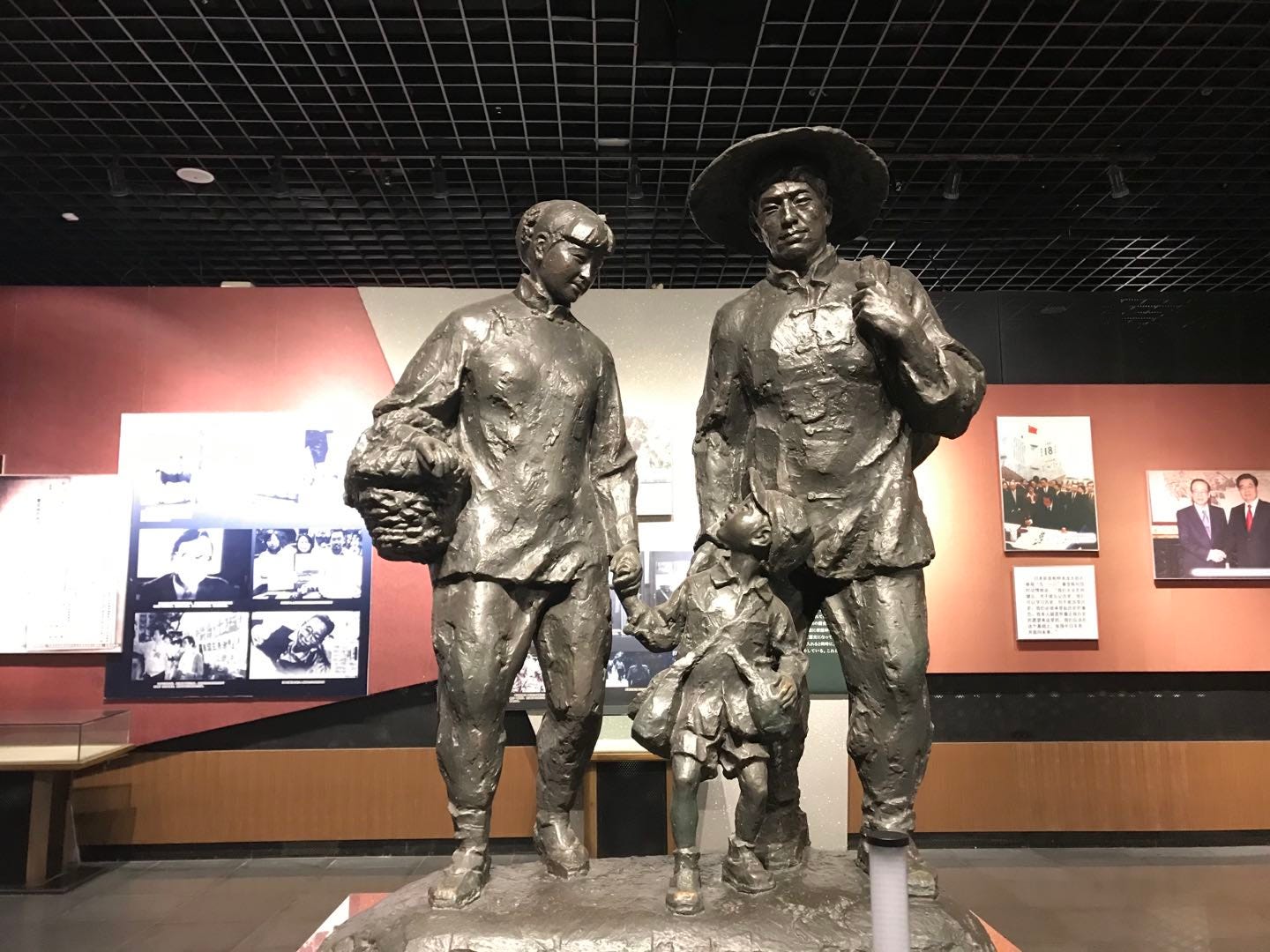
Over 4,000 Japanese war orphans were left behind in China at the conclusion of World War Two, with over 90% of these orphans being the children of settlers17. Rather than being treated with the hatred that The Poppy War depicts, these orphans were adopted by Chinese foster parents and gradually able to repatriate to Japan, although this process was delayed by the government which had abandoned them in China, with Japanese war orphans winning a suit against the Japanese state for its negligence in 200618. The Japanese Empire’s abandonment of its impoverished settlers also resulted in the deaths of an estimated 5,000 people attempting to flee the Fangzheng county of northern China, and it was Mao’s Premier Zhou Enlai who ordered the construction of the China-Japan Friendship Garden in the 1960s—a cemetery devoted to these same 5,000 victims of Japanese imperialism19. It’s these efforts on the part of the Chinese foster parents and the communist party which reveals the bankruptcy of Kuang’s grim-dark approach to the Nikara’s war of resistance. Japanese war orphans certainly faced resentment within China, but if our analysis understands the layers of Western racism which constituted the victimization of the Chinese and Koreans by the Japanese in World War Two and earlier, it becomes less surprising that these same orphans often faced poverty and further discrimination upon returning to Japan for their “Chinese upbringing”20.
Kuang’s first novel does not contain this complex dialectic where the Japanese Empire’s racism came to victimize even the beneficiaries of its efforts at settler-colonialism—whereas the Chinese people sheltered and honored their fellow victims. Rin’s transformation over the course of the novel feels hollow as a result of this lack of understanding. Kuang wants the audience to marvel at the depths of Rin’s rage, but she seems to forget that it was not rage but ruthlessness which makes her own protagonist engaging. Rin starts the novel by surpassing nobles through an unparalleled devotion to developing herself:
“She had needed failure to remind her that she wasn’t like the Sinegardians—she hadn’t grown up speaking casual Hesperian, wasn’t familiar with the command structure of the Imperial Militia, didn’t know the political relationships between the Twelve Warlords like the back of her hand. The Sinegardians had this knowledge ingrained from childhood. She would have to develop it.
“Every waking hour that she didn’t spend in class, she spent in the archives. She read the assigned texts out loud to herself; wrapping her tongue around the unfamiliar Sinegardian dialect until she had eradicated all hints of her southern drawl.
“She began to burn herself again.21 She found release in the pain; it was comforting, familiar. It was a trade-off she was well used to. Success required sacrifice. Sacrifice required pain. Pain meant success.”22
It’s this level of dedication which makes Rin compelling, not the unbridled hatred which fuels her later acts against the Mugen Federation. The novel reaches odd contradictions in its characterization of Rin thanks to this progression from ruthless self-development to hateful soldier. Kuang’s stated goal to follow the creation of a monster via the lens of Japanese invasion feels internally superfluous given that Rin already reaches conclusions of total war before experiencing the trauma of the Federation’s invasion:
“You’re trapped in this valley. The villages have mostly evacuated, but the Federation general holds a school full of children hostage. He says he will set the children free if your battalion surrenders. You have no guarantee he will honor the terms. How do you respond?” …
Rin raised her hand. “Cut around the second army and get onto the dam. Break the dam. Flood the valley. Let everyone inside drown.”
Her classmates turned to stare at her in horror.
“Leave the children,” she added. “There’s no way to save them.” …
“Runin, please elaborate.”
“It’s not a victory either way,” said Rin. “But if the costs are so high, I would throw all my tiles in. This way they die, and we lose half our troops but no more. Sunzi writes that no battle takes place in isolation. This is just one small move in the grand scheme of the war. The numbers you’ve given us indicate that these Federation battalions are massive. I’m guessing they constitute a large percentage of the entire Federation army. So if we give up some of our own troops, we lessen their advantage in all subsequent battles.”23
Rin poses a logical hypothesis, and it’s to Kuang’s credit that she engages with this question rather than hiding in moral platitudes. Instead of some character rebuking Rin for daring to consider this form of warfare, Rin is forced to logically assess her own tactic and rejects it based on a conclusion not far off from the holistic view of war emphasized earlier by Mao:
“The tactic would have worked. We might have even won the war. But no ruler would have chosen that option, because the country would have fallen apart afterward. My tactic doesn’t grant the possibility of peace.”
“Why is that?” Irjah pressed.
“Venka was right about destroying the agricultural heartland. Nikan would suffer famine for years. Rebellions like the Red Junk Opera would spring up everywhere. People would think it was the Empress’s fault that they were starving. If we used my strategy, what would happen next is probably a civil war.”24
If the novel continued to engage with questions of warfare along this line of logical effect rather than moral grounds, it would form a far more coherent text. Instead, Rin’s final act is conceived as “her vengeance … divine retribution for what the Federation had wreaked on her people. This was her justice”25. The Poppy War’s portrayal of the Mugen Federation justifies the necessity of Rin’s act while morally condemning her by tying her motives to rage rather than the calm logic which prompted her earlier defense of total war tactics. Compare this confusion with a work like Bertolt Brecht’s The Good Person of Szechwan, which poignantly acknowledges the necessity of callous methods for positive goals:
“In order to win one’s mid-day meal
One needs the toughness which elsewhere builds empires.
Except twelve others be trampled down
The unfortunate cannot be helped.
So why can’t the gods make a simple decision
That goodness must conquer in spite of its weakness?—
Then back up the good with an armored division
Command it to: ‘fire!’ and not tolerate meekness?”26
That The Poppy War fails to communicate this difficult truth despite its fidelity to certain aspects of history can be traced back to Kuang’s conceit that Rin should mirror Mao Zedong—or more accurately, the liberal notion of him. The novel suffers the exact same logical breakdowns that liberal notions of the Russian and Chinese Revolutions do when they try to explain their perceived implosions by way of psychoanalytic ideas regarding hatred, envy, and power-hungriness. That Rin’s characterization contradicts itself in its attempts to explain Mao’s supposed trajectory from an efficient war hero to an irrational monster hearkens back to a general truth of the novel identified by Walter Benjamin:
“‘A man who dies at the age of thirty-five, said Moritz Heimann once, ‘is at every point of his life a man who dies at the age of thirty-five.’ Nothing is more dubious than this sentence—but for the sole reason that the tense is wrong. A man—so says the truth that was meant here—who died at thirty-five will appear to remembrance at every point in his life as a man who dies at the age of thirty-five. In other words, the statement that makes no sense for real life becomes indisputable for remembered life. The nature of the character in a novel cannot be presented any better than is done in this statement, which says that the ‘meaning’ of his life is revealed only in his death.”27
This foreknowledge stains The Poppy War’s plot and characters throughout its length, although rather than having a character’s physical death in mind, Rin’s whole trajectory is subverted by Kuang’s expectation of her death as a heroic figure. One at first receives the sense from the novel that an emotionally-driven ending was arbitrarily forced onto a character originally defined by their ruthlessness, but it’s more likely that Rin’s compelling beginning had to be constructed in order to set up her preconceived fall. As a result, The Poppy War is a supremely disappointing novel. Kuang’s immense talent is put at the disposal of a lazy liberal theme which conflates the oppressed with their oppressors. Rin’s beginnings demonstrate that Kuang could have written a novel where the necessary costs of liberation are measured according to their internal logic and actual effect, but instead we receive a plot where characters are morally condemned for acts urged on by the world-building of the novel itself. As a representation of Japan’s invasion of China, The Poppy War succeeds in part, but as a metaphor for the rise of Mao Zedong, it fails entirely.
Bibliography
Malone, Alice (@alicirce). “I really like RF Kuang’s Babel.” X, January 21, 2023. https://x.com/alicirce/status/1616875550337019906.
Yu, Alan. “In The Poppy War Series, R.F. Kuang Asks: 'What If Mao Was A Teenage Girl?’.” NPR, November 24, 2020. https://www.npr.org/2020/11/24/937995479/in-the-poppy-war-series-r-f-kuang-asks-what-if-mao-was-a-teenage-girl.
Kuang, R.F. The Poppy War. New York: Harper Voyager, 2019. (p. 330)
Ibid. (p. 533)
Ibid. (p. 432)
Ibid. (p. 277)
Ibid. (p. 213)
Ibid. (p. 515)
“It took us a devilishly long time to figure out how it spreads. Fleas, can you believe that? Fleas, that latch onto rats, and then spread their little plague particles over everything they touch. Of course, now that we know how it spreads, it’s only a hop step to turning it into a weapon. Obviously it will not do to have the weapon run around without control—we do plan to inhabit your country one day—but when released in some densely populated areas, with the right critical mass … well, this war will be over much sooner than we anticipated, won’t it?”
Ibid. (p. 481)
Ibid. (p. 432)
Ibid. (p. 422)
Ibid. (p. 504)
Alperovitz, Gar. “Did America Have To Drop the Bomb? Not to End the War, But Truman Wanted To Intimidate Russia.” The Washington Post, August 3, 1985. https://www.washingtonpost.com/archive/opinions/1985/08/04/did-america-have-to-drop-the-bombnot-to-end-the-war-but-truman-wanted-to-intimidate-russia/46105dff-8594-4f6c-b6d7-ef1b6cb6530d/.
Mao Zedong. “The Situation and our Policy After the Victory in the War of Resistance Against Japan.” Marxists Internet Archive, 2004. https://www.marxists.org/reference/archive/mao/selected-works/volume-4/mswv4_01.htm.
Wolin, Richard. Heidegger in Ruins. New Haven: Yale University Press, 2022. (p. 204)
James. C.L.R. The Black Jacobins. New York: Vintage Books, 1989. (p. 373)
Wang Xiaonan and Zhao Yue. “The Bond: Japanese War Orphans and their Chinese Parents.” CGTN, September 18, 2021. https://news.cgtn.com/news/2021-09-18/The-bond-Japanese-war-orphans-and-their-Chinese-parents--13ET4O9NrhK/index.html.
McCurry, Justin. “Japanese ‘War Orphans’ Win Compensation.” The Guardian, December 1, 2006. https://theguardian.com/world/2006/dec/01/secondworldwar.japan.
Wang Xiaonan and Zhao Yue. “The Bond: Japanese War Orphans and their Chinese Parents.” CGTN, September 18, 2021. https://news.cgtn.com/news/2021-09-18/The-bond-Japanese-war-orphans-and-their-Chinese-parents--13ET4O9NrhK/index.html.
McCurry, Justin. “Japanese ‘War Orphans’ Win Compensation.” The Guardian, December 1, 2006. https://theguardian.com/world/2006/dec/01/secondworldwar.japan.
Rin develops a studying tactic of lighting candles and burning herself with the melting wax to maintain her focus.
Kuang, R.F. The Poppy War. New York: Harper Voyager, 2019. (p. 94)
Ibid. (p. 97)
Ibid. (p. 101)
Ibid. (p. 502)
Brecht, Bertolt. The Good Person of Szechwan. Translated by John Willett. London: Methuen & Co, 1965. (p. 48-9)
Benjamin, Walter. “The Storyteller.” In Illuminations, 83-107. London: The Bodley Head, 2015. (p. 99-100)