
Critiquing Empire with Opulence
An Analysis of Arkady Martine's "A Memory Called Empire"

Modern fantasy and science fiction have moved towards unprecedented heights of representation in non-white and queer characters, dragged towards this development by the inescapable tide of global progress. However, this transition remains incomplete as attempts to meet rising demands for social justice implement better representation without fully breaking with the husk of liberalism, retaining the ideology’s exclusionary impulses under each stories’ “radical” shell.
George R.R. Martin’s A Song of Ice and Fire foreran this phenomena. Women in his books use political and physical skill to advance their positions, but these positions are entrenched in a feudal hierarchy where the internal intrigue of the ruling class is centered to the exclusion of the class conflict which actually comprises history, with the “smallfolk” of Westeros treated as cruel idiots easily manipulated by various characters driven by an abstract pursuit of power. The presence of “strong female characters” in these books belies Martin’s determination to uphold and aestheticize feudal hierarchy, even if that aestheticization contains cynical, lurid contours rather than the hagiography of the high fantasy which preceded him. In the process, not only are classist tropes reinforced, but the fountainhead of medieval misogyny is enshrined as a cruel but inescapable reality, with only characters imbued with a mystic birthright, i.e. Daenerys and Rhaenyra Targaryen, given the agency to struggle against this system—for the sake of their personal ascension.
A Song of Ice and Fire shows how classism remains embedded in the fantasy genre, even in stories presenting themselves as a radical critique of the prior iterations of the genre. Science fiction suffers a similar history of dystopian works which hint at anti-capitalist themes while relying on Orwellian myths of “brainwashing” and a perfect surveillance state, thereby turning the ruling class into an unbeatable fixture of a cynical worldview. But while these genres are historically entrenched in a liberal bias which upholds the current ruling class via the analogous feudal aristocracy or Orwellian state, we live in a literary moment which has begun to digest and react to the deficiencies of works like A Song of Ice and Fire. Hence, there is not only a need to progress past the classism of prior and current genre fiction, but a growing wealth of stories which combine the greater representation within modern sci-fi and fantasy with a more insightful analysis of the politics these settings rely on.
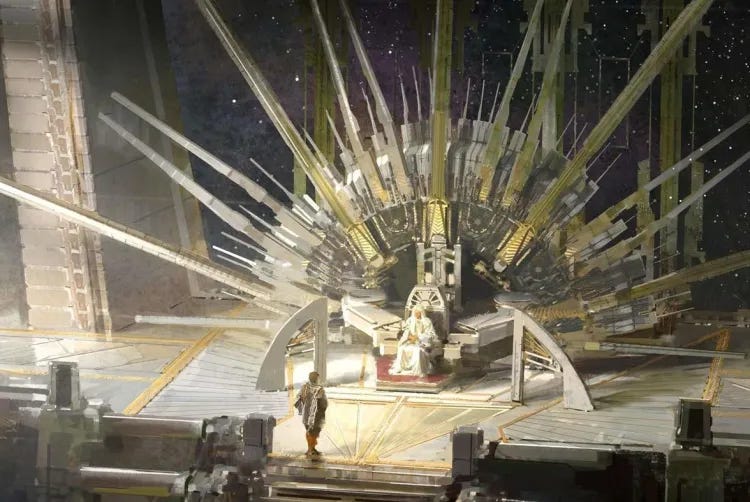
Arkady Martine’s A Memory Called Empire is a triumphant, anti-imperialist step in this direction, albeit a step which simultaneously illuminates the limits of the space opera genre. It is a story about an intergalactic empire, Teixcalaan, threatening to annex the protagonist, Mahit’s, home, yet the plot and cast of characters are embedded in the intrigues of the Teixcalaanli court and Mahit’s infatuation with Teixcalaanli culture. It is a dramatic structure which threatens to recreate the worst impulses of the fantasy genre’s interaction with political structures by centering the personal motives of aristocrats and indulging itself in the beauty of their status symbols, yet A Memory Called Empire succeeds in its depiction by analyzing how the poetic, exclusionary language of Teixcalaan works to constantly reproduce empire and assert its hegemony over those not yet in its grasp.
Mahit is chosen as the ambassador of Lsel Station to Teixcalaan due to her aptitude in the latter’s language and culture, yet this very language is built around reinforcing the separation between Teixcalaanli citizens and those barbarians existing outside its borders. This separation allows Teixcalaan to mirror the real-life separation between the normalized violence waged abroad by the US military and the existentially dreaded violence of civil war within the borders of US empire. The emperor of Teixcalaan, Six Direction, reflexively voices this difference in regards to his empire’s fear of internal unrest:
“There were border skirmishes reported every week. There’d been an outright rebellion put down on the Odile System just a few days back. Teixcalaan was not peaceful. But Mahit thought she understood the difference Six Direction was so fixated on: those were skirmishes that brought war to outside the universe, to uncivilized places. The word he’d used for ‘world’ was the word for ‘city.’ The one that derived from the verb for ‘correct action.’”1
This exclusion, baked into the language and logic of Teixcalaan, both frustrates Mahit’s desire to fully immerse herself in Teixcalaanli culture, while demonstrating the full power of that culture. Teixcalaan records its history through epics and conducts its political affairs through poetry, and the novel never questions that these products hold genuine beauty and artistic merit, just as a logical assessment of US empire cannot wholly dismiss the creations of Hollywood as a “degenerate” morass. And just as with Hollywood, the real danger of these cultural products comes from a monopolization of artistic talent and means of production, a monopoly funneled towards the production of works which place Teixcalaan—or the US—as the center of civilization, with the rest of the world converted into a peripheral Other. The effects of this cultural hegemony are material, with Lsel Station losing its people just as real countries in the Global South suffer “brain drain”. This threat creates the tension between the ambassador preceding Mahit, Yskandr, and the leaders of Lsel Station:
“Yskandr Aghavn: you want to invite Teixcalaan in. You speak poetry and you send back reams of literature, and more of our children every year take the aptitudes for the Empire and leave us. Leave us bereft of who they might have been. You are a corrosive poison.”2
Martine emphasizes the importance of these cultural works to the preservation of Teixcalaan via collective memory, but the novel is also rife with plot details which hint at the ultimate fragility of this system. Unlike fantasy or sci-fi works which exclusively focus on the inner power struggles of the ruling class, A Memory Called Empire shows anti-imperial Teixcalaanli factions to be a constant and swelling threat to the empire, complementing and urging the power struggles between imperial aristocrats. While the novel’s focus on the Lsel ambassador and her interactions with the imperial court distances its focus from the everyday oppression and destitution wrought by empire, it manages to weave in enough detail to show that the struggle for the imperial throne has economic elements rather than simply being a matter of personal ambition. The two would-be emperors, Thirty Larkspur and One Lightning, respectively showcase the nebulous divide between a traditional bourgeois liberal and a fascistic populist, united in preservation of empire but divided on their navigation of the delicate self-image tying Teixcalaan together:
“Mahit thought of the fundamental assumption of Teixcalaanli society: that collapse between world and Empire and City—and how if there was such a collapse, importation was uneasy, foreign was dangerous, even if that importation was just from a distant part of the Empire … If Nine Maize was pointing out the threat of importation, he was calling for—or at least suggesting—that Teixcalaan act to normalize that threat. To civilize it. And Teixcalaan had always civilized—had always made something Teixcalaanli—with force. Force, like a war. Nine Maize wasn’t really talking to Thirty Larkspur; Nine Maize was shoring up whatever political factions were preparing for war …
“‘Where are One Lightning’s supporters tonight, Three Seagrass?’ she asked. ‘They’re who that poem was for. For anyone who is interested in a stronger, more centralized, less importation-focused Teixcalaan.’”3
A Memory Called Empire deftly navigates the tensions which threaten to unravel Teixcalaan—and thereby imperial systems in general, but the conclusion of the novel complicates this theme. Mahit and Yskandr are continually drawn into the orbit of the sitting emperor, Six Direction, and his advisor Nineteen Adze, helping them triumph over the threats to his dynasty and stabilizing the empire itself in the process. There are pragmatic reasons for this alignment within the logic of the novel, with Lsel Station exploiting Six Direction’s fragility to cut a deal for its independence, and the outright romantic love felt by Yskandr for Six Direction forms an analogy for his and Mahit’s hopelessly one-sided attraction to Teixcalaanli culture. However, Lsel Station’s independence and the Teixcalaan Empire’s unity are only permitted thanks to an encroaching threat by a non-human force.
The novel deliberately presents this force as an unknown threat to be encountered properly in the next novel, but in doing so, it tacitly justifies the exclusionary logic of Teixcalaan, with Mahit using the threat to exploit the Teixcalaanli concept of inclusion: “I can prove that there is an active threat to the borders of Teixcalaan. We are all in danger from these aliens”4. With the aliens depicted in the novel as a force which can’t be reasoned with—unlike Teixcalaan—Martine’s world-building talents encounter a persistent problem in science fiction: Any alien species must be sufficiently inhuman to justify its alien status without being deprived of the diversity and emotional intelligence which characterizes a sentient species invested with rights and a peer status to humanity.
Star Trek infamously fails in the first part of this balance, with its aliens generally being human actors bestowed with pointy ears or wrinkly foreheads, while space operas in the vein of Warhammer 40k turn most of their aliens into completely irredeemable hordes of destruction5. A Memory Called Empire has implied its alien threat to be closer to the latter, but I hope that its sequel, A Desolation Called Peace, will complicate this depiction by expanding on a theme established at the first novel’s outset. One of the leaders of Lsel Station sees the encroaching alien threat as an opportunity, hoping that “perhaps there is an empire larger than the Empire that has been devouring us by inches”6. This hope expresses the logic of multipolarity: that vulnerable states in the Global South gain resistance to imperialism by being able to play hegemonic states against each other. For this theme to be properly expressed, the unnamed alien threat will have to gain the logic that the first novel implied them to lack.
Even before reading its sequel, I can gladly say that A Memory Called Empire accomplishes a necessary subversion of the space opera genre by stretching its aristocratic aesthetics to expose the fragile concoction of exclusion and cultural hegemony which characterizes empire. Where authors like George R.R. Martin sluice their fantasy worlds in cynicism, sex, and gore, ending up with a depressing affirmation of the feudal status quo, Arkady Martine has analyzed empire by picking it apart at its most opulent and revealing the danger within this beauty. The sci-fi and fantasy genres do not require a gritty tone to be radical; they only need to intelligently show that the fixtures of these settings contain the fragility of their real-life counterparts.
Bibliography
Martine, Arkady. A Memory Called Empire. New York: Tor, 2019. (p. 237)
Ibid. (p, 240)
Ibid. (p. 175-6)
Ibid. (p. 411)
Sci-fi novels which offer positive examples of this balance include Octavia Butler’s Dawn and Cixin Liu’s The Three-Body Problem. The extraterrestrial societies in these books are shaped by their physical adaptations without implying a lack of complexity among their sentient individuals.
Martine, Arkady. A Memory Called Empire. New York: Tor, 2019. (p. 15)