
At the Party's Expense
The Meaning and Creation of Professional Revolutionaries

The Democratic Socialists of America claim a membership exceeding 80,000,1 yet the number of Democratic Socialists on the party’s payroll only exceeds 30.2 For an organization claiming to span all 50 states, that is a proportion of 1 paid employee to every 2,666 general members. For the largest leftwing organization of the United States, one which claims to be the best hope for revolution in the settler republic, that is an estimated 1 full-time revolutionary to every 11.6 million people in the US.3 I imagine the DSA would agree with my implication that this is a woefully inadequate number for the task at hand, but that does not mean that the exact proportion of fully committed revolutionaries to part-time members or non-party civilians is agreed upon, nor even the ideal nature of these three categories in an effective revolution.
When I say full-time revolutionary, I am making several assumptions. I am first assuming that these 30 people on DSA payroll work the customary 40 hours a week, which says nothing about the nature of this work. Furthermore, I am leaving as a grey area the countless hours of volunteered labor by DSA members who are not on the party’s payroll, which doubtlessly comprises the majority of its—and possibly the whole US leftwing’s—organized political labor. Is this volunteered activism the engine of progress in the US, or is it the function of individuals whose work is entirely devoted to the revolution? This question’s equivalent in the Russian Empire was asked and addressed by Lenin in his concept of the professional revolutionary, but he was explicit that the foundational text of this concept, What Is to Be Done? (WITBD), “is a summary of Iskra tactics and Iskra organizational policy in 1901 and 1902 … no more and no less.”4 To answer the questions we’ve gathered about modern revolutionaries, we must first observe this original context and the implications rippling out from it.
The Necessity of Professionals
Professional revolutionaries were forged as a tactic during the repression and illegality of communists in the Russian Empire. When Lenin contrasted an organization of a few professional revolutionaries to a mass organization of members, he contextualized the latter as something ludicrous in the Bolsheviks’ specific context: “Only an incorrigible utopian would have a broad organization of workers, with elections, reports, universal suffrage, etc., under the autocracy.”5 At the same time, these principles were being argued for when the largest party in Europe was the Social Democratic Party of Germany, which the Russian factions Lenin was contending with pointed to as a broad, mass organization touting democratic processes. Lenin did not reject these features, nor did he accept this picture at face value:
“Take the Germans. It will not be denied, I hope, that theirs is a mass organization, that in Germany everything proceeds from the masses, that the working-class movement there has learned to walk. Yet observe how these millions value their ‘dozen’ tried political leaders, how firmly they cling to them … Political thinking is sufficiently developed among the Germans, and they have accumulated sufficient political experience to understand that without the ‘dozen’ tried and talented leaders (and talented men are not born by the hundreds), professionally trained, schooled by long experience, and working in perfect harmony, no class in modern society can wage a determined struggle. The Germans too have had demagogues in their ranks who have flattered the ‘hundred fools’, exalted them above the ‘dozen wise men’, extolled the ‘horny hand’ of the masses … and have spurred them on to reckless ‘revolutionary’ action and sown distrust towards the firm and steadfast leaders.”6
This picture places revolutionary leaders into a dialectic with mass organization, rather than presenting the two as contrasting forms of party-building. It furthermore paints a picture of flourishing social democracy in a Global North context which must be compared with our modern day. Rather than party leaders—professionals who write and organize for the revolution—the modern US left finds its figureheads in elected officials like Zohran Mamdani and Bernie Sanders who maintain a deliberate separation from the actual structure of the DSA.7 Even if we allege that the US has a mass leftwing organization, it lacks the dialectical relationship with leaders which characterized the revolutions of Russia, China, and the other communist states. Going further, Lenin characterized the conditions of Russia as necessitating a higher concentration of professional revolutionaries than the German party which eventually fell to reformism and splits:
“We can never give a mass organization that degree of secrecy without which there can be no question of persistent and continuous struggle against the government. To concentrate all secret functions in the hands of as small a number of professional revolutionaries as possible does not mean that the latter will ‘do the thinking for all’ and that the rank and file will not take an active part in the movement. On the contrary, the membership will promote increasing numbers of the professional revolutionaries from its ranks”8
In the Russian context, where Lenin saw the autocracy as necessitating a higher concentration of professional revolutionaries, the connection with the masses is not severed but forms the foundation which the organization springs from, rather than its immediate body. Lenin’s concept of the professional revolutionary—even if more urgently needed in the context of the Russian Empire—has relevance in both conditions of legality and illegality, and it is always interconnected with the working masses, even if those masses do not comprise the majority of the revolutionary party. Therefore, before we analyze the professional revolutionary in any particular modern context, we must first explore the extent to which the professional revolutionary was defined in itself.
The Meaning of the Term
Lenin’s use of the term professional revolutionary was not an explicit innovation defined at its outset. It was a term applied to existing conditions which became refined through practice as the Bolsheviks progressed through their struggle. Within the text of WITBD, the term is used to refer to a range of roles far exceeding those engaged in “the art of combating the political police”9, containing as well the specializations of the “professional agitator, organizer, propagandist, literature distributor, etc., etc.”10 This variety and the term’s application to both the German and Russian contexts led to an ambiguity in WITBD which has led analysts of the text, like Lars Lih, to question the originality and importance of professional revolutionaries as an independent concept: “‘Revolutionary by trade’ was thus a rhetorical enforcement of Lenin's various organizational arguments and not a new conception in itself. We should take care not to read too much into it.”11 Along this line of argument, Lih makes claims which distance the concept of professional revolutionaries from a guiding role in the new communist party: “Lenin is not proposing any monopoly of decision-making by the revolutionaries by trade. In general, WITBD has little to say about party governance.”12
The text of WITBD allows this interpretation, but Lenin’s continued writing after that text directly contradicts it. Responding to a comrade’s request for organizational feedback the year after WITBD, Lenin said outright: “The leadership of the movement should be entrusted to the smallest possible number of the most homogeneous possible groups of professional revolutionaries with great practical experience.”13 Lih’s conception of the “revolutionary by trade” seeks to replace this leadership by a distinct form of party member with a professional, specialized approach to revolutionary skills:
“The metaphor of a trade does not carry some of the implications an English speaker might import into the word ‘professional revolutionary’. A ‘professional revolutionary’ might be thought of as akin to a professional soldier, a mercenary who goes from trouble spot to trouble spot, selling his skills. Or a ‘professional revolutionary’ might be like a doctor or a lawyer—a prestigious middle-class expert who tells the ignorant worker what to do. There is, in fact, no implication in the metaphor itself that the revolutionary by trade is a non-worker intellectual … On the contrary—the intellectual is satirized for lack of seriousness in learning a trade. Thus the ultimate aim of the metaphor is to portray the revolutionary as part of the worker's world, as a fellow skilled laborer in the great factory of revolution.”14
This picture correctly separates Lenin from a patronizing attitude towards proletarians who entered the party. He said in WITBD: “We are directly to blame for doing too little to ‘stimulate’ the workers to take this path, common to them and to the ‘intellectuals’, of professional revolutionary training, and for all too often dragging them back by our silly speeches about what is ‘accessible’ to the masses of the workers, to the ‘average workers’, etc.”15 However, the implications within Lih’s overall analysis ignore this progression of professional revolutionaries from the ranks of workers to the leadership of the party. Lih’s contention that the “revolutionary by trade” is merely a “fellow skilled laborer in the great factory of revolution” enforces a muddled picture in which Lenin assigned no leadership priority to professional revolutionaries. Furthermore, his concern that the term professional revolutionary may evoke the image of a “professional soldier, a mercenary who goes from spot to spot” ignores the fact that this is in many ways a common theme we will witness in the history of the Bolsheviks and the international communist movement.
Lih’s replacement of the role of professional revolutionary with the “trade” of revolution robs Lenin’s organization theory of its structural advice for the communist party. This is not the case for the Marxist-Leninists who succeeded Lenin. In the History of the Communist Party of the Soviet Union (Bolsheviks) produced by the party’s central committee, professional revolutionaries are explicitly defined as “Party workers free from all occupation except Party work and possessing the necessary minimum of theoretical knowledge, political experience, organizational practice and the art of combating the tsarist police and of eluding them.”16 Ergo, professional revolutionaries were both fully devoted to party work and versed in a common foundation of revolutionary skills necessary to operate in that environment. They were considered an integral feature of a Party consisting of “two parts: a) a close circle of regular cadres of leading Party workers, chiefly professional revolutionaries … and b) a broad network of local Party organization and a large number of Party members enjoying the sympathy and support of hundreds of thousands of working people.”17
The Traveling Revolutionary
When we think about the relationship between these two parts and Lih’s concern with the “mercenary” professional revolutionary, Lenin’s advice on the creation of professional revolutionaries in WITBD is revealing:
“In a great many cases these forces are now being bled white on restricted local work, but under the circumstances we are discussing it would be possible to transfer a capable agitator or organizer from one end of the country to the other, and the occasion for doing this would constantly arise. Beginning with short journeys on Party business at the Party’s expense, the comrades would become accustomed to being maintained by the Party, to becoming professional revolutionaries, and to training themselves as real political leaders.”18
How familiar is Lenin’s description of being “bled white” on restricted local work? The US leftwing parties constantly reproduce this pattern through their stagnation, and Lenin points to a more mobile, party-funded revolutionary as the cure. Precisely in their ability to work in various locales to coordinate and educate party workers, the professional revolutionary is a unique, essential asset. The enabling of their travel at the party’s expense is a stepping stone to the goal of full-time party professionals. When describing this evolution at further length in the context of the German SDP, Lenin positions the professional revolutionary as a rare gem polished through travel and exchange with a wide variety of experiences:
“Look at the Germans: their forces are a hundredfold greater than ours. But they understand perfectly well that really capable agitators, etc., are not often promoted from the ranks of the ‘average’. For this reason they immediately try to place every capable working man in conditions that will enable him to develop and apply his abilities to the fullest: he is made a professional agitator, he is encouraged to widen the field of his activity, to spread it from one factory to the whole of the industry, from a single locality to the whole country … he broadens his outlook and increases his knowledge; he observes at close quarters the prominent political leaders from other localities and of other parties.”19
The Bolsheviks inherited this tactic from the reformist SDP, founding the Communist International to coordinate action between parties and directly training revolutionaries from other nations in USSR-based universities, such as with the “Communist University of the Toilers of the East” which trained Ho Chi Minh and other Asian revolutionaries while the later “International Lenin School” trained cadres from Western Europe.20 While Lih’s image of a mercenary revolutionary who makes revolution wherever they are has little basis, travel and a certain level of universally applicable revolutionary skills characterize a unique, all-encompassing role for key members of the communist party, one whose training transcended national borders and supported the anti-colonial movement. In addition to Ho Chi Minh’s Soviet education, we find that Kim Il Sung’s time with other revolutionaries in Jilin, China provided “a lifelong ideological and moral foundation. My accumulation of knowledge and experience in Jilin enabled me to build the framework of an independent revolutionary thought in the future.”21
There are innumerable examples of party leaders who engaged in these educative stays abroad, and each story contains the common denominator that this travel and the revolutionary community which came with it cost the traveler both time and money—not always with a party available to cover these costs. This fact brings us to the elephant in the room regarding professional revolutionaries. Of course having personnel fully devoted to revolutionary work is a boon. Of course party leaders are more effective if they are able to concentrate fully on this work, and if they can draw on a varied experience which can be shared freely without concern for national or regional boundaries. The question remains how we attain this capacity, particularly when the established parties of the US lack this strategy or ability, and the conditions of the Comintern no longer exist.
Creating Professional Revolutionaries
Thankfully, the lessons of the past serve us here as well. When Antonio Gramsci immersed himself into the Italian communist movement, it was while studying at the University of Turin and sustaining himself through a special scholarship fund for impoverished Sardinian students.22 Gramsci joined the Socialist Youth Federation between 1912-13, although he was initially inactive according to his later political partner Palmiro Togliatti, who described Gramsci as experiencing a problem I imagine many US communists will find familiar: “[Gramsci] seemed ‘rather narrow in his concerns, and still full of doubts about what course to pursue.’”23 After continuing his studies and witnessing “the sight of large peasant masses participating for the first time in political action” during the first Italian elections with universal male suffrage in 1913, Gramsci “began to devote more and more of his time to the Socialist movement.”24 His profession began as an “extraordinarily effective teacher” of young workers in the movement.25 While Gramsci worked enough to strain his constitution, suffering frequent “headaches, dizzy spells, [and] stomach trouble,” this strain was not focused on his studies, resulting in Gramsci’s poor attendance and his failure to complete his degree.26
After his time in university, Gramsci maintained his full-time commitment to the communist movement as a journalist: “the Young Sardinian devoted himself exclusively to the Socialist press, deriving his only income from this work.”27 While at this point Gramsci could be supported by the Socialist Party and its eventual successor in the Italian Communist Party he helped form, his journey to that point should be illustrative for us in the modern Global North. His scholarship fueled his transformation into a professional revolutionary, but it was not a journey in which his educational career and his political life could remain in harmony. Gramsci exploited his scholarship for an unintended purpose, and it produced the foremost figure of Italian communism. Similarly, Huey P. Newton gained the education and contacts at Merritt College which would inform the founding of the Black Panther Party, but even his successful completion of a degree was characterized by this conflict between academic ambition and immersion in the revolutionary struggle:
“In school the ‘system’ was the teacher, but on the block the system was everything that was not a positive part of the community. My comrades on the block continued to resist that authority, and I felt that I could not let college pull me away, no matter how attractive education was. These brothers had the sense of harmony and communion I needed to maintain that part of myself not totally crushed by the schools and other authorities.”28
This picture is by no means meant to imply that a higher education and a revolutionary profession are contradictory paths—Newton cited “my studying and reading in college” as what “led me to become a socialist.”29 But one of these paths must take supremacy or both will suffer. While there is a danger of romanticizing revolutionary self-sacrifice, Lenin was clear in his later writings on the professional revolutionary that its ideal form involved total absorption. Speaking after the death of Y.M. Sverdlov, Lenin upheld him as a model to emulate:
“He dedicated himself entirely to the revolution in the very first period of his activities, when still a youth who had barely acquired political consciousness. In that period, at the very beginning of the twentieth century, Comrade Sverdlov stood before us as the most perfect type of professional revolutionary, a man who had entirely given up his family and all the comforts and habits of the old bourgeois society, a man who devoted himself heart and soul to the revolution, and who for many years, even decades, passing from prison to exile and from exile to prison, cultivating those characteristics which steeled revolutionaries for many, many years.”30
This level of commitment will only increase in necessity as the consequences of revolutionary activity grow under US repression. The funds required to produce a revolutionary of this type are not found in maintaining a full-time career in addition to one’s revolutionary work, but in manipulating existing conditions to enter the revolutionary field fully and then maintaining oneself through revolutionary work. It’s the acquisition of funds which becomes the key concern in this transition. In the Russian Empire, intellectuals dominated the original ranks of the professional revolutionaries because of their wealth’s ability to sustain them during their submersion into the movement. However, this is only a temporary arrangement which produces revolutionaries rife with petit bourgeois sensibilities who Lenin—himself a product of a petit bourgeois background—sought to surpass:
“Not only are revolutionaries in general lagging behind the spontaneous awakening of the masses, but even worker-revolutionaries are lagging behind the spontaneous awakening of the working-class masses … This fact proves that our very first and most pressing duty is to help to train working-class revolutionaries who will be on the same level in regard to Party activity as the revolutionaries from amongst the intellectuals (we emphasize the words ‘in regard to Party activity’, for, although necessary, it is neither so easy nor so pressingly necessary to bring the workers up to the level of intellectuals in other respects). Attention, therefore, must be devoted principally to raising the workers to the level of revolutionaries; it is not at all our task to descend to the level of the ‘working masses’ as the Economists wish to do, or to the level of the ‘average worker’ as Svoboda desires to do.”31
The creation of a party which can facilitate this movement to proletarian revolutionaries is still a necessity in the modern day. Most of the communists reading this—myself included—cannot be classified as professional revolutionaries. We are students and workers who devote a slice of our time to revolutionary work while the lion’s share remains monopolized by other priorities. People matching this description will absolutely form a key part of the movement, but this is a distinct role from the professional revolutionary. Lenin contended with the notion that his separation of the professional revolutionary from the sympathetic masses erased these intermediaries:
“For a whole chain of links occurs, beginning from the handful making up the highly secret and close-knit core of professional revolutionaries (the center) and ending with the mass ‘organization without members.’ I point out merely the trend in the changing character of the links: the greater the ‘mass’ character of the organization, the less definitely organized and the less secret should it be—that is my thesis. And you want to understand this as meaning that there is no need for intermediaries between the mass and the revolutionaries! Why, the whole essence lies in these intermediaries! And since I point out the characteristics of the extreme links and stress (and I do stress) the need for intermediate links, it is obvious that the latter will have their place between the ‘organization of revolutionaries’ and the ‘mass organization.’”32
In view of this lesson, we should never shame those intermediaries who devote only part of their activities to the movement, but neither should those of us who purport to be communists rest content with our current level of activity. The need for professional revolutionaries means that we must periodically re-evaluate our paths and seize those opportunities to advance more of us to the role of professional revolutionary. If this is not possible on a personal scale, we need to accept the role of intermediary while also refusing to believe that a party can lead the movement without a network of links between professional revolutionaries, intermediaries, and sympathetic masses. Promoting the professional revolutionary core of this movement needs to be a priority, and its necessity was such in Lenin’s time that he felt the need to deliberately exaggerate its importance for the sake of correcting the prior state of confusion.
“To maintain today that Iskra exaggerated (in 1901 and 1902!) the idea of an organization of professional revolutionaries, is like reproaching the Japanese, after the Russo-Japanese War, for having exaggerated the strength of Russia’s armed forces, for having prior to the war exaggerated the need to prepare for fighting these forces … Today the idea of an organization of professional revolutionaries has already scored a complete victory. That victory would have been impossible if this idea had not been pushed to the forefront at the time, if we had not ‘exaggerated’ so as to drive it home to people who were trying to prevent it from being realized.”33
To take Lenin’s metaphor further and into our present moment, any accusations that the need for professional revolutionaries is exaggerated risks implying that we are exaggerating the capabilities and violence of the ruling class. In the face of emboldened mass repression enacted by ICE, it is hard to stomach the notion that threats to vulnerable peoples and revolutionaries in the US could be exaggerated. Professional revolutionaries are needed both to structure a vanguard party and to improve our defenses against political repression. The Bolshevik example becomes more and more relevant in this regard given their operatives’ need to learn how to navigate prisons, exile, and covert movement between nations. Within the modern intensification of reactionary violence and the legal repression of revolutionaries, professional revolutionaries must train both to navigate this terrain and to acquire the funds which can be used to multiply their own numbers.
Reaching Above and Below the Proletariat
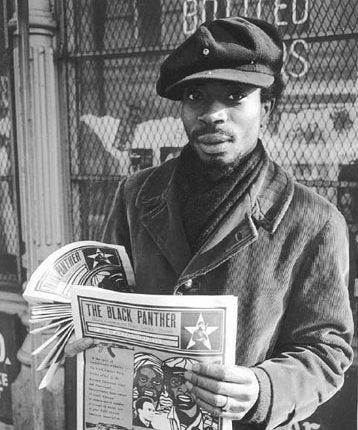
When we discuss the acquisition of funds, there are both legal and illegal methods which have been historically employed by revolutionaries. These methods have included both obvious ones such as membership dues, and more creative and memorable methods such as the Black Panthers’ sale of copies of The Quotations of Mao Zedong:
“We went over to the China Book Store in San Francisco and we bought up two batches of the Red Book, thirty in a package, and got back over here and we sold them motherfuckers at Cal campus some Red Books … We made a deal with the bookstore. We told them, ‘We are the Black Panther Party, and could an organization get a discount?’ and the next thing I knew, we had enough money to buy two shotguns.”34
This example is illustrative because Bobby Seale describes the direct flow of funds into weapons which served to earn the Party publicity and recruits. However, while some methods will remain relatively unchanged, such as membership dues, others must change to reflect modern conditions. The Red Book—and information media in general—have been digitized to an extent where selling paperbacks and newspapers as the Panthers did no longer holds the same potential, even as the digital landscape opens other avenues of funds. The essential lesson to carry over from these earlier forms is the direct flow from forms of financial gain into revolutionary conditions. The Panthers put their money directly into weaponry which allowed them to demonstrate the cowardice of the police and the intrinsic rights of their people. If this money had been hoarded or applied haphazardly to the maintenance of existing resources without a plan for expansion, the party’s embryo might’ve stagnated.
We cannot name an ideal form of revenue suited to every given modern scenario, but we can establish principles against inefficient policies of fundraising. The example of the Panthers shows funds being raised to directly advance the level of struggle, whereas modern fundraising is easily bogged down by an unclear plan for these expenses and nebulous goals surrounding their usage. On top of advancing the conditions of struggle, clear terms of use for the funds gathered through membership fees and other methods keeps those contributing to the movement informed and motivated. We should consider this anecdote by Lenin to be a constant criticism of opaque parties:
“I recall that once a comrade told me of a factory inspector who wanted to help the Social-Democrats, and actually did, but complained bitterly that he did not know whether his ‘information’ reached the proper revolutionary center, how much his help was really required, and what possibilities there were for utilizing his small and petty services. Every practical worker can, of course, cite many similar instances in which our primitiveness deprived us of allies … Had we a real party, a real militant organization of revolutionaries, we would not make undue demands on every one of these ‘aides’, we would not hasten always and invariably to bring them right into the very heart of our ‘illegality’, but, on the contrary, we would husband them most carefully and would even train people especially for such functions, bearing in mind that many students could be of much greater service to the Party as ‘aides’ holding some official post than as ‘short-term’ revolutionaries.35
As with the offering of one’s labor or information, financial offerings must be reinforced through an appropriate level of information and a visible, sustained momentum supported by one’s contribution. Lenin furthermore highlights a principle of slowly immersing members of the movement into the illegality of revolution. This warning is relevant to our understanding of professional revolutionaries—it is better for some to remain in “official posts” as covert allies of the revolution than to burn themselves out via a haphazard, noble dive into the depths of communist action. The illegality of these depths also characterizes the conclusions we must reach regarding funding and the function of the professional revolutionary. To fight the rising viciousness and security technology of the settler-state, the requirements of struggle have grown, both in terms of the skills needed to protect revolutionary talent and subvert reactionaries and in terms of getting the funds needed for these tasks.
When the Revolution of 1905 shook the Russian Empire, rightwing socialists warned against the contact that theft and violence against the state brought between revolutionaries and criminal groups, i.e. the lumpenproletariat. This relationship is a topic in itself, but Lenin’s response to this backlash is revealing for our focus: “Social-Democracy knows of no universal methods of struggle, such as would shut off the proletariat by a Chinese wall from the strata standing slightly above or slightly below it.”36 His advice that some intermediaries are better served remaining in their official posts as covert allies of the revolution recognizes that petit bourgeois allies are a fact of the revolution, even if they are not outright class traitors as Lenin himself was. As with the movement’s relationship with petit bourgeois individuals, so too did revolutionaries overlap with “the strata … slightly below it.”
Even in the most critical definitions of the lumpenproletariat, this nebulous group contains an intense variety of skills and experiences. Marx did not define the lumpen as a fully-fledged class below the proletariat. They are instead “scum, offal, refuse of all classes”37 with many examples given to emphasize the broad walks of life this “refuse” originates in:
“Alongside decayed roués with dubious means of subsistence and of dubious origin, alongside ruined and adventurous offshoots of the bourgeoisie, were vagabonds, discharged soldiers, discharged jailbirds, escaped galley slaves, swindlers, mountebanks, lazzaroni, pickpockets, tricksters, gamblers, maquereaux [pimps], brothel keepers, porters, literati, organ grinders, ragpickers, knife grinders, tinkers, beggars—in short, the whole indefinite, disintegrated mass, thrown hither and thither, which the French call la bohème”38
In the context of this broad swathe of de-classed elements, those petit bourgeois class traitors who align themselves with the revolution are a form of lumpenproletariat, at least within their transition to being “full-time” professional revolutionaries. We can especially witness this kernel in Marx’s inclusion of “literati”—in the original German, “Literaten,” meaning “writers” via modern translation.39 Would Marx not be considered de-classed “refuse” by his own definition? Regardless of our answer, the fact remains that between literati, discharged soldiers, and porters are skills obviously beneficially to be harnessed by the revolution, and there is no limit of this truth to those lumpenproletariat operating within the law. Huey Newton, who sustained himself for a time on burglaries and “first studied law to become a better burglar”40 outlined explicitly that criminal actions could be redirected into communist organizing:
“This recruiting had an interesting ramification in that I tried to transform many of the so-called criminal activities going on in the street into something political, although this had to be done gradually. Instead of trying to eliminate these activities—numbers, hot goods, drugs—I attempted to channel them into significant community actions. Black consciousness had generally reached a point where a man felt guilty about exploiting the Black community. However, if his daily activities for survival could be integrated with actions that undermined the established order, he felt good about it. It gave him a feeling of justification and strengthened his own sense of personal worth. Many of the brothers who were burglarizing and participating in similar pursuits began to contribute weapons and material to community defense. In order to survive they still had to sell their hot goods, but at the same time they would pass some of the cash on to us. That way, ripping off became more than just an individual thing.”41
This phenomenon is not limited to the Black Panthers. The Communist Party of China incorporated criminal organizations into its work: “Even the Elder Brother Society, an ancient secret organization, was brought into Soviet life and given open and legal work to do.”42 As implied by Lenin’s refusal to separate the proletarian movement from those strata above or below it, criminal methods were an accepted aspect of revolutionary periods for the Bolshevik leader, most notoriously embodied by those robberies which the Bolsheviks deemed “expropriations”:
“In the Party’s latest report, showing a total income of 48,000 rubles for the year, here figures a sum of 5,600 rubles contributed by the Libau branch for arms which was obtained by expropriation … Nobody will be so bold as to call these activities of the Lettish Social-Democrats anarchism, Blanquism or terrorism. But why? Because here we have a clear connection between the new form of struggle and the uprising which broke out in December and which is again brewing … The fact that ‘guerrilla’ warfare became widespread precisely after December, and its connection with the accentuation not only of the economic crisis but also of the political crisis is beyond dispute. The old Russian terrorism was an affair of the intellectual conspirator; today as a general rule guerrilla warfare is waged by the worker combatant, or simply by the unemployed worker … we must realize what forms of struggle inevitably arise under such circumstances, and not try to shirk the issue by a collection of words learned by rote, such as … anarchism, robbery, hooliganism!”43
The professional revolutionary is a combination of education, funds, and those skills forged in the disintegrating corners of capitalist society. Following Lenin’s words, we must recognize that the exact proportions of petit bourgeois and lumpenproletarian influence on a professional revolutionary’s development changes just as much as the number of these professionals and the party’s capacity to support them grows over time. Fully-fledged professional revolutionaries are proletarian in the truest sense of this class descriptor, but it takes a heterogeneous path to reach this leading role.
To conclude with one more point on the need for this role, let us return to those 30 full-time employees of the DSA. How many professional revolutionaries did the Bolsheviks have? A 1986 study by a Soviet scholar indicated that before the Russian Social Democratic Labour Party’s 2nd Congress in 1903 (shortly after the publishing of WITBD in 1902), the party had nearly 200 professional revolutionaries engaged in illegal work.44 For an empire with roughly a third of the population now existing in the US, this number already dwarfs what the modern US leftwing possessed, and it by no means represents the heights of a revolutionary movement which only succeeded over a decade later. This in mind, we can close on one last quote from WITBD: “Have no fear, gentlemen! Remember that we stand so low on the plane of organization that the very idea that we could rise too high is absurd!”45
Bibliography
"DSA Home Page.” Retrieved December 31, 2025. https://www.dsausa.org/.
Duhalde, David. “DSA’s Staff Members Deserve Dignity.” Socialist Majority, February 28, 2024. https://www.socialistmajority.com/theagitator/staffdignity.
Based on an estimated 348 million people in the US, in January 2026
Lenin, V.I. “Preface to the Collection Twelve Years.” In Lenin: Collected Works, vol 13. Moscow: Progress Publishers, 1962. (p. 102)
Lenin, V.I. “What Is to Be Done?” In Lenin: Collected Works, vol 5. Moscow: Progress Publishers, 1960. (p. 459)
Ibid. (pp. 461-2)
Mays, Jeffery C., Dana Rubinstein, and Eliza Shapiro. “Mamdani Distances Himself From Democratic Socialists’ National Agenda.” The New York Times, August 28, 2025. https://www.nytimes.com/2025/08/28/nyregion/mamdani-dsa-socialist-mayor.html.
Ibid. (p. 465)
Ibid. (p. 466)
Ibid. (p. 472)
Lih, Lars T. Lenin Rediscovered. Chicago: Haymarket Books, 2008. (p. 463)
Ibid. (p. 464)
Lenin, V.I. “A Letter to a Comrade on our Organisational Tasks.” In Lenin: Collected Works, vol 6. Moscow: Progress Publishers, 1961. (p. 246)
Lih, Lars T. Lenin Rediscovered. Chicago: Haymarket Books, 2008. (p. 460)
Lenin, V.I. “What Is to Be Done?” In Lenin: Collected Works, vol 5. Moscow: Progress Publishers, 1960. (p. 473)
History of the Communist Party of the Soviet Union (Bolsheviks): Short Course. New York: International Publishers, 1939. (p. 33)
Ibid. (p. 33)
Lenin, V.I. “What Is to Be Done?” In Lenin: Collected Works, vol 5. Moscow: Progress Publishers, 1960. (p. 508)
Ibid. (p. 472)
Duiker, William J. Ho Chi Minh: A Life. New York: Hyperion, 2000. (p. 92)
Kim Il Sung. With the Century, vol 1. Pyongyang: Foreign Languages Publishing, 1994. (p. 219)
Cammett, John M. Antonio Gramsci and the Origins of Italian Communism. Stanford: Stanford University Press, 1967. (p. 17)
Ibid. (p. 32)
Ibid. (p. 33)
Ibid. (p. 33)
Ibid. (p. 18)
Ibid. (p. 41)
Newton, Huey P. Revolutionary Suicide. New York: Penguin Books, 2009. (p. 75)
Ibid. (p. 70)
Lenin, V.I. “Speech in Memory of Y. M. Sverdlov” In Lenin: Collected Works, vol 29. Moscow: Progress Publishers, 1965. (p. 90-1)
Lenin, V.I. “What Is to Be Done?” In Lenin: Collected Works, vol 5. Moscow: Progress Publishers, 1960. (p. 508)
Lenin, V.I. “To P. G. Smidovich.” In Lenin: Collected Works, vol 34. Moscow: Progress Publishers, 1966. (p. 108-9)
Lenin, V.I. “Preface to the Collection Twelve Years.” In Lenin: Collected Works, vol 13. Moscow: Progress Publishers, 1962. (p. 102)
Seale, Bobby. Seize the Time: The Story of the Black Panther Party. Arrow Books, 1970. (p. 102)
Lenin, V.I. “What Is to Be Done?” In Lenin: Collected Works, vol 5. Moscow: Progress Publishers, 1960. (p. 469)
Lenin, V.I. “Guerrilla Warfare.” In Lenin: Collected Works, vol 11. Moscow: Progress Publishers, 1972. (p. 221)
Marx, Karl. The Eighteenth Brumaire of Louis Bonaparte. Marxists Internet Archive, 1995. https://www.marxists.org/archive/marx/works/download/pdf/18th-Brumaire.pdf. (p. 38)
Ibid. (p. 38)
Marx, Karl. Der 18. Brumaire des Louis Bonaparte. Projekt Gutenberg, 1972. https://projekt-gutenberg.org/authors/karl-marx/books/der-18-brumaire-des-louis-bonaparte/chapter/2/.
Newton, Huey P. Revolutionary Suicide. New York: Penguin Books, 2009. (p. 79)
Ibid. (p. 134-5)
Snow, Edgar. Red Star Over China. New York: Grove Press, 1968. (p. 221)
Lenin, V.I. “Guerrilla Warfare.” In Lenin: Collected Works, vol 11. Moscow: Progress Publishers, 1972. (p. 217-8)
Lih, Lars T. Lenin Rediscovered. Chicago: Haymarket Books, 2008. (p. 465)
Lenin, V.I. “What Is to Be Done?” In Lenin: Collected Works, vol 5. Moscow: Progress Publishers, 1960. (p. 473)
Very interesting